May 17, 2007

European Lisp Workshop '07 - news

As already announced, this year's European Lisp Workshop will be held in Berlin on July 30, again in conjunction with ECOOP. There are two noteworthy news items:

See the workshop website for more information.

April 24, 2007

ELW'07

There will be a new instance of the European Lisp Workshop at ECOOP 2007 in Berlin, Germany on July 30. The deadline for submission of long papers, short essays and/or proposals for breakout groups is May 13. Please see the ELW'07 website for more information.

Reflective Layer Activation in ContextL

I have just uploaded the paper Reflective Layer Activation in ContextL to my website that we have presented at this year's ACM Symposium on Applied Computing.

This paper describes some aspects of the metaobject protocol of ContextL. This is not exactly the same version as presented at the symposium, but the paper has been updated to reflect the new API in ContextL 0.4. However, apart from the resulting changes of function names and a few other minor edits, the contents have remained the same.

April 21, 2007

ContextL 0.40.

I have just released version 0.40 of ContextL. The idea is that this version is feature-complete with regard to the feature set of the upcoming 1.0 release. The goal is now to test this version extensively, and to write a documentation of the current features and the API of ContextL before version 1.0 is eventually released.

There have been some changes in the API which are listed at the ContextL homepage. These are mostly cosmetic changes, like better names for functions, etc.

However, there are also some new features. The most interesting ones are probably several readers for the main ContextL metaclasses, such that the introspective part of ContextL is now complete, and a function current-layer-context. The latter can be used to capture the set of currently active layers, which can later be reinstalled for example with funcall-with-layer-context. Current-layer-context should be interesting for example to "inherit" active layers to/from threads in multithreaded Common Lisp implementations, or to capture active layers alongside continuations such that they can both be reinstalled together later on. This could, for example, be interesting in conjunction with continuation-based web frameworks.

For more details, see the ContextL homepage and announcements/discussions in the closer-devel mailing list.

April 09, 2007

My impressions of ILC'07

I am posting this as an individual member of the Lisp community. I am not speaking for the ILC'07 organizers. (Oh man... ;)

I am very happy that ILC'07 turned out to be so successful. This hasn't been always clear during the preparations, so I guess all the organizers breathed a sigh of relief when the numbers of registrations started to increase (and we suddenly had to come up with ideas how to manage a situation in which we nearly had too many registrations ;).

Among the "generic" highlights, I personally enjoyed the atmosphere a lot. I am convinced that this is mainly due to the fact that almost everyone had their accommodation at the same place. In my experience, conferences where this is the case are typically more successful - you already see the participants in the morning during breakfast, you have a lot more time to talk to each other, and so on.

For me, it was also nice to see so many people again. On average, the number of smart people is a lot higher at Lisp meetings than elsewhere, so there is always a chance to have some very interesting discussions with very different perspectives provided by everyone.

About the conference itself, I am happy that the program chair (JonL White) has carefully selected a very interesting set of presentations. Almost all talks were of high quality, covering a broad range of topics with only a couple of downers. My personal highlights have been:

  • Antonio Leitao's work on translating Java source code to idiomatic (!) Common Lisp sources. He has already done the reverse (translating a subset of Common Lisp to Java) in the past and is now heading towards a solution that potentially improves the situation on the library front for Common Lisp. The interesting aspect here is the focus on generating idiomatic code, i.e., code as if it had been written manually by experts in the respective target languages.

  • Mike Sperber's illuminating talk about R6RS Scheme. I had some fears wrt having this presentation for an audience that mostly consists of Lispers, but non-Schemers. However, Mike has given a very entertaining talk and helped everyone to have a better idea about the goals of R6RS. (IMHO, it's important that Schemers and Lispers talk more to each other because both sides can learn from each other. I'm glad that ILC'07 has helped improve the situation a little bit.)

  • Manuel Serrano has given a very impressive presentation about his HOP framework for developing web applications in Scheme. It's good to see that there are a couple of approaches that head in the right direction of enabling the creation of GUIs that makes users' lives easier instead of focusing on solving technicalities of accidental elements in the underlying technology (for example, the infamous "back" button). I see HOP in the same line as Marc Battyani's (unfortunately unpublished) web framework, but as far as I can tell, Manuel has gone a few steps further.

  • Alexander Repenning had a paper about X-expressions in XMLisp, which sounds a lot more boring than what he actually presented. This is not yet another library for dealing with XML, but actually modifies the Common Lisp reader (parser) to treat XML as syntax for literal CLOS objects. The applications that he has built on top of that technology are very impressive indeed.

  • Clemens Fruhwirth's Liskell is actually a very simple idea. He takes GHC - a widely used implementation of Haskell - and replaces the Haskell syntax with s-expressions. This enables, among other things, the inclusion of macros. I have always wanted to take a closer look at Haskell, but its syntax always put me off. Now I don't have an excuse anymore. ;)


For obviously personal reasons, I am also very happy that Charlotte Herzeel's presentation about HALO is so well-received - she got a lot of positive feedback for her presentation. However, it is only an overview of HALO, there is still more to come. I hope that we can report on some exciting results soon.

On the negative side about ILC'07, it seems to me that the program was maybe a little too packed - we had to get up very early in the morning (very hard for me ;), and there was maybe not enough time to engage in discussions or even do some work with other attendees. We have tried to establish a breakout group format, but apparently we haven't found the right approach yet. Ralf Mattes suggested a birds-of-a-feather-sessions format to me, so maybe that's something we should look into for the future.

A real downer was the annual meeting of the Associations of Lisp Users (ALU). It wasn't the first time they promised to become more "professional", but their presentation to the ALU members was worse than average. I hope they will manage to get their act together. Otherwise, it will be hard for them to be taken seriously by the Lisp community in the long run. It is worth noting, though, that they are responsible for backing the International Lisp Conference, so they must be doing something right... ;)

Fortunately, the rest of the conference didn't suffer from the ALU meeting - the day after was as good as, or maybe even a little more exciting than, the other days on all levels.

Next on the schedule is the European Lisp Workshop, co-located with ECOOP 2007 and taking place in Berlin on July 30, and most likely sometime early next year another instance of the European Common Lisp Meeting.

March 08, 2007

Lisp Bleep Survivalism

A few tidbits:

  • Registrations for the International Lisp Conference 2007 are coming in like crazy, and we are soon running out of rooms at the Clare College. There are only three days left until the early registration deadline with reduced fees, so there are enough reasons to better hurry up. ;)

  • New videoclips by Motor and Nine Inch Nails.

  • This is the last posting about music to this blog, since the postings here occur, for example, at Planet Lisp. So in order to stop boring Lispers about music they are not interested in, I will post all music-related ramblings to the freshly brewed infox_blog instead.

February 27, 2007

What is the point of macros?

One of the distinguishing features of Lisp and Scheme is the ability to define macros that allow you to extend the base language with new language constructs. Here are two examples what this actually means and why this is a good idea.


Let's take a common idiom from Java: Whenever you want to open a file, process its contents, and close it again afterwards, you have to write code roughly like this:

FileInputStream in = new FileInputStream(filename);
try {
doSomething(in);
} finally {
in.close();
}

Note how the orange code is the code that you are actually interested in: That's the part that states which file you want to open, that you want to open it for reading, and that you want to do something with the file. The rest is just idiomatic code that you have to write just to make the machinery work: You declare a variable outside of the try block (this is important for the visibility of the variable!), and you have to put the call of the close method in a finally block to ensure that the file is always closed even when an exception occurs.

The problem here is that you have to write this code over and over and over again, and everytime you write this code, you have to get the details right. For example, when I was still a Java hacker, I always have put the variable declaration inside the try block, just to get the error message from the compiler that this is wrong. This is annoying - it would be nice if I didn't have to think about this. (I have actually gotten it wrong again in the first version of this posting. Go figure.)

Here is the same code in Common Lisp:

(let ((in (open filename)))
(unwind-protect
(do-something in)
(close in)))

This is not yet an improvement: The orange part of the code is still deep down in other code that just ensures that the machinery for opening and closing the file works. I still have to declare the variable first (here with a let), I still have to use the Lisp-equivalent of try-finally (here it's called unwind-protect), and I still have to ensure that the closing of the file happens as part of the clean-up step of an unwind-protect.

However, Lisp gives us a way to get rid of the idiomatic code. What we would actually like to write is this:


(with-input-file (in filename)
(do-something in))


This code states exactly what we want and nothing else: We want to execute some code with an open file bound to some variable, and we implicitly want to ensure that it is closed again at the end of this code fragment.

Here is a macro that defines this construct:

(defmacro with-input-file ((variable filename) &body body)
`(let ((,variable (open ,filename))
(unwind-protect
(progn ,@body)
(close ,variable))))

Here is an explanation of the code:

  • The macro is defined with defmacro and we name it like the language construct we want to build. It takes two variables: a variable name and a piece of code that will give us the filename in the resulting code. It also takes a body of code for the with-input-file construct.

  • The macro creates a piece of code that the Lisp compiler should use instead of the original code that uses the with-input-file construct: We basically define a code template in which the variable, filename and body spots are filled in with the parameters that the macro receives.

  • Some minor details: The progn groups a number of expressions into one - this is similar to grouping code in a pair of curly braces in Java. The backquote, comma and comma-at notations are there to clarify how the parameters should be inserted - that's something that you can better learn in good Lisp tutorials.


Although writing macros takes a little practice, it is very straightforward once you are used to doing this. Macros help you to avoid typing a lot of idiomatic code: whenever you notice some coding pattern, you can put it in some macro and then use it instead.

Syntactic Abstractions


Let's get a little closer to the heart of what macros actually are: They provide you with a way to define syntactic abstractions. Abstractions are used for hiding away implementation details that client code should not be interested in. For example, in classes you can define private fields and methods for internal use and define a public interface that client code has to go through to ensure that the internal details are always used properly. Likewise, with functional abstractions - closures - you can pass around a function that can refer to variables in its lexical environment without giving anyone direct access to these lexical variables.

Many implementation details can be hidden very well with such abstraction mechanisms. However, others cannot be hidden well, and this is when macros become interesting.

For example, assume that your language doesn't provide any iteration constructs but requires you to use recursion instead. You can relatively easily build your own iteration constructs - for example a while function - like this in Lisp:

(defun while-function (predicate block)
(if (not (funcall predicate)) (return))
(funcall block)
(while-function predicate block))

This function works as follows: It takes a predicate function and a block of code, also provided as a function. When calling the predicate (with funcall) returns false, the while-function returns. Otherwise, the block is executed (again with funcall) and then the while-function calls itself again.

Here is an example of using the while-function:

(let ((i 0))
(while-function (lambda () (< i 10))
(lambda ()
(print i)
(incf i))))

This code fragment increments i from 0 up to 10 and prints i at each step. This piece of code doesn't look very nice. One reason is that Lisp's lambda construct is somewhat lengthy. Smalltalk, Ruby, and other languages have nicer syntax for lambda expressions, and would make this code shorter. However, even then there is a problem here: We still have to write idiomatic code to write a while loop although we are actually not interested in the idiom. Here, the idiomatic element is the use of a lambda expression to ensure that some code is not immediatily executed, but only later under the control of the while-function. However, what we actually want to say is this, which doesn't contain any idiomatic code at all:

(let ((i 0))
(while (< i 10)
(print i)
(incf i)))

And, as you might have guessed, here is a macro to implement this while construct:

(defmacro while (expression &body body)
`(while-function (lambda () ,expression)
(lambda () ,@body)))

This macro uses the while-function in the code that it creates. This is actually one of the typical ways to write Lisp code: We first define the functional (or object-oriented, or imperative, or whatever) abstractions, and then we add some syntactic layer on top to make the code look nicer, and especially to hide away implementation details that we cannot hide otherwise.

Why is it so interesting to hide away implementation details, like the use of lambda expressions to delay evaluation? Well, we could actually decide not to use lambda expressions at all in our expansion. Here is an alternative implementation of the while macro:

(defmacro while (expression &body body)
`(tagbody
start (if (not ,expression) (go end))
,@body
(go start)
end))

Yes, Common Lisp provides the tagbody construct inside which you can use go, i.e., a goto statement! Gotos are not a very good idea to use in your own code, but gotos are very useful for generating efficient code in macros. In this second implementation of the while macro, there is for example no need anymore to allocate space for the closures that the two lambda expressions create, because we can simply jump around the code to delay its execution.

Of course, this is a toy example, so the little gain in efficiency here is probably not worth the effort. However, what is important is that the "API" for the while macro hasn't changed at all compared to the first version. You still write this:

(let ((i 0))
(while (< i 10)
(print i)
(incf i)))

That's one of the important advantages of abstractions: You can change internal implementation details while all the client code can be left unchanged!

And this is the whole point of macros: You can abstract away code idioms that you cannot astract away in any other way, and you effictively have a lot more options to change implementation details without affecting any clients.

Macros are also one of the fundamental reasons for why Lispers like Lisp's strange syntax so much: The syntax is a direct representation of what is elsewhere called the abstract syntax tree, and the fact that the AST is directly available for manipulation as a very simple list data structure makes it so straightforward and convenient to implement and use macros.

If you now have gotten the taste of this, you may want to read some more introductory material about Lisp, like my own opinionated guide, Peter Seibel's excellent book about Common Lisp, or any of the other available tutorials.

February 21, 2007

Call for Participation: ILC'07

INTERNATIONAL LISP CONFERENCE 2007

Clare College, Cambridge, England - April 1-4, 2007

In cooperation with ACM SIGPLAN

Sponsored by The Association of Lisp Users


The Association of Lisp Users is pleased to announce the 2007 International Lisp Conference will be held in Cambridge, England at Clare College from April 1st to 4th, 2007. This year's program consists of tutorials at beginners' and advanced levels, prominent invited speakers from the Lisp and Scheme communities, an excellent technical session, tours of Central Cambridge, Anglesey Abbey and Ely, and a quintessential English experience: a traditional dinner served in the college's Great Hall. The advance registration deadline is March 11th. The ILC'07 programming contest is also still running until March 3rd.


Schedule


  • Saturday, March 31st


  • Sunday, April 1st


    • Tutorials and workshops

      • Ernst van Waning, Extended Tutorial: Common Lisp in One Day

      • Pascal Costanza, Context-oriented Programming in Common Lisp

      • Richard Brooksby, Improve your Lisp using the Memory Pool System

      • Duane Rettig, Optimizing and Debugging Programs in Allegro CL


  • Monday, April 2nd


    • Invited presentations

      • Christian Queinnec, Teaching CS to undergraduates at UPMC

      • Michael Sperber, It's All about Being Right: Lessons from the R6RS Process

      • Herbert Stoyan, Lisp: Themes and History

    • Presentations of accepted papers


  • Tuesday, April 3rd


    • Invited presentations

      • Jans Aasman, Scalable Lisp Applications

      • Ralf Moeller, Building a Commercial OWL Reasoner with Lisp

      • Manuel Serrano, HOP: An Environment for Developing Web 2.0 Applications

    • Presentations of accepted papers

    • Annual meeting of the Association of Lisp Users

    • Conference banquet


  • Wednesday, April 4th


    • Invited presentations

      • Richard Jones, Dynamic Memory Management

      • John Mallery, Lisp/CL-HTTP

    • Presentations of accepted papers


  • Thursday, April 5th


Conference Registration


Conference registration is now open. The advance registration deadline is March 11th. You can get further discounts as an ACM/SIGPLAN and/or ALU member. Registration includes: access to all events, morning and afternoon teas / coffees, self-service lunch, banquet (Tuesday April 3rd), proceedings and hopefully a conference t-shirt. Accomodation is available in Clare College's "Memorial Court". Credit cards and PayPal are accepted, as are cheques (sterling or US dollars) and international bank transfers.


Organizing Committee


  • Co-Chairs: Carl Shapiro (SRI International), Pascal Costanza (Vrije Universiteit Brussel)

  • Members: Rusty Johnson (ALU), Peter Lindahl (ALU)

  • Program Chair: JonL White (The Ginger Ice Cream Factory / ALU)

  • Local chair: Nick Levine (Ravenbrook / ALU)

  • General correspondence: ilc07-organizing-committee at alu.org


Mailing Lists


General conference announcements are made on a very occasional basis to the low-volume mailing list ilc07-announce. If you're thinking of participating in ILC 2007, you should either join this list or take an occasional look at the archives.

February 05, 2007

Let's Lisp again!

There are several news about this year's International Lisp Conference to be held in Cambridge, UK in the first week of April.


  1. The Register has published a press release about the conference. Nick Levine told me that it's a good idea to "digg" this article (whatever that means ;). Apparently, you can do this directly via this entry at digg.

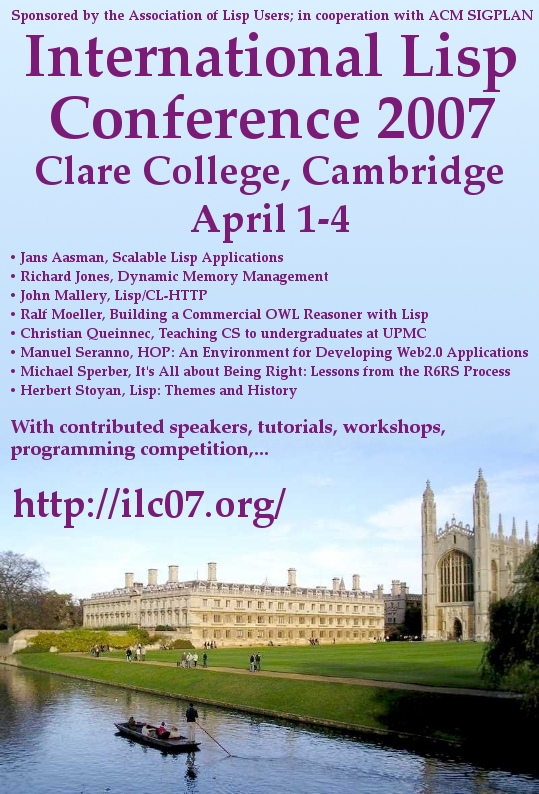
  2. There is a conference poster available for download. Please print it off and distribute it everywhere.

  3. Finally, you can show off your Lisp programming skills by providing implementations for the conference's programming contest.

January 21, 2007

Best Albums of 2006

Here is my list of music recommendation based on what I perceived being the most interesting albums that I have listened to in 2006. This time, it is not a "best of" list, like last year, but a more careful breakdown.

First of all, the best albums that were released this year are as follows.

1. The Knife - Silent Shout.

It took me a while to get into this album. I had seen recommendations in a few places that I check every now and then, and since they are on Mute Records in the US they caught my attention. However, listening to clips of this album didn't help me at first. The first track, "Silent Shout", sounded to me like a uninspired copy of Kraftwerk, and the second one, "Neverland", like an uninspired piece of electronic punk. However, when I have seen the video clip for "We Share Our Mother's Health" in Kevin Holy's Ten Best Music Videos of 2006, I got it. I bought the album, and since then I almost exclusively listen to it. I can strongly recommend "The Captain", "We Share Our Mother's Health" and "Marble House".

2. Kate Havnevik - Melankton.

Another act from Sweden. I have listened to this a lot and considered this to be the best album of 2006 until very recently. This one is especially interesting because it is the very first album I have bought just because of a recommendation at the iTunes Music Store - I have never heard of this singer before. I can especially recommend the following tracks: "Unlike Me", "Nowhere Warm" and "Suckerlove".

3. Motor - Klunk.

I have already discussed this album before. They have supported Nitzer Ebb on their reunion tour, and Motor have been fabulous.

4. Lou Rhodes - Beloved One.

The first solo album from the singer of Lamb. Recommended tracks: "Treat Her Gently", "No Re-Run" and "Beloved One".

There were also new releases Laibach ("Volk") and Tanya Tagaq (Sinaa - I haven't heard of her before, but she was mentioned at Björk's website). Both are quite interesting and impressive, but I still have to make up my mind before final judgment.

Underworld have already started the "RiverRun Project" in 2005, but I only heard about it in 2006. It is a series of mp3 files (together with comprehensive artwork) that you can buy at their website. Since these are not commercially released on CD, they are quite free-form, which is good. I can especially recommend Lovely Broken Thing, which is part 1 in that series.

Apart from these albums, I have finally managed to get a better overview of Swans. Love of Life has always been one of my favorite albums for about ten years now, but I never took the time to take a look at their other releases (which are quite numerous). I have now listened to quite a few of their albums during this year, and I can recommend Children of God / World of Skin as a good starting point because it captures the different musical styles of Swans quite well.

Two good "best of" collections that were released in 2006 are Collected by Massive Attack and "Body of Work" by Nitzer Ebb. Apart from that, I currently listen to Tekel, who capture the sensibilities of 80's electronic pop music quite well.

That's it for now. Looking forward to new releases by Skinny Puppy, Komputer, Nine Inch Nails and Recoil in 2007...

October 22, 2006

International Lisp Conference '07 - Call for Papers

The call for papers for the International Lisp Conference 2007 is out. Please consider submitting papers about all Lisp- or Scheme-related topics. This time, the conference will be in Cambridge / UK in the first week of April 2007.

September 20, 2006

Freely downloadable books by Niklaus Wirth.

I haven't been aware of the fact that quite a few books by Niklaus Wirth are available as free downloads by now. Among them are such classics as Programming in Modula-2, Algorithms and Data Structures, Compiler Construction, and Project Oberon, all of them either originally in/about Oberon, or adapted to Oberon.

These books have influenced me a lot. Niklaus Wirth's main strength is a focus on the essentials, which is especially apparent in his concise programming style. I can especially recommend Compiler Construction which basically contains all you need to know about compilers in a very thin book (unless you decide to make this your field of expertise), and Project Oberon which contains the complete source code of a full operating system (including a file system, a garbage collector, a GUI, and so on).

See also the ETH Oberon Home Page for more information about Oberon and related materials.

CDR 0 & 1 finalized.

The Common Lisp Document Repository (CDR) has finalized its first documents today. CDR 0 describes CDR and the CDR process itself, while CDR 1 is the CLOS MOP specification, as published as an appendix in The Art of the Metaobject Protocol by Kiczales, des Rivières and Bobrow.

These CDRs were mostly test runs of the CDR process, although they are of course also useful in their own right. (The CLOS MOP had already been published over 15 years ago and has long been proven useful, so didn't really need an official "stamp.")

See the CDR website for more information.

Furthermore, we have set up a CDR Blog where we will post CDR-related announcements - actually the same ones as in the cdr-announce mailing list.

August 24, 2006

Efficient Layer Activation for Switching Context-dependent Behavior

This is a paper that I have written together with Robert Hirschfeld and Wolfgang De Meuter, and we are going to present it at the Joint Modular Languages Conference (JMLC'06) in Oxford next month. The paper discusses how the CLOS Metaobject Protocol is used to implement the features of ContextL and presents a benchmark that shows that ContextL is quite efficient - not significantly worse than CLOS, which itself can be implemented very efficiently. So context-oriented programming does not seem to place a significant burden on applications in this regard.

The benchmark is based on an example that is frequently used to discuss aspect-oriented programming, especially control-flow-related features like the cflow construct in AspectJ. In our paper, we do not use an aspect-oriented solution, but obviously one based on context-oriented programming. That solution requires repeated activations and deactivations of layers, so this is indeed a useful benchmark for ContextL. These repeated activations and deactivations do not add any significant overhead to a similar program that does not activate or deactivate layers at all. To the contrary, in CMUCL and SBCL, the runs with repeated activations / deactivations are actually faster than the ones without. This means that other factors play a more important role with regard to efficiency. The benchmark is part of the ContextL release, so you can run it in your own environment.

The paper uses a Java-style syntax instead of the original Lisp syntax. We have decided to do so to make the paper more accessible to non-Lispers. However, I will use the original ContextL version for the presentation at the conference.

The paper can be downloaded from my website.

August 10, 2006

Common Lisp Document Repository

CDR - The Common Lisp Document Repository

What?

The Common Lisp Document Repository is a repository of documents that are of interest to the Common Lisp community. The most important property of a CDR document is that it will never change: if you refer to it, you can be sure that your reference will always refer to exactly the same document.

Why?

There have been a number of attempts to establish a standardization process for Common Lisp after it has been officially published as an ANSI standard. The ANSI standardization was very costly and very time consuming (according to http://groups.google.com/group/comp.lang.lisp/msg/15248a1b11c5a603 it took nearly 10 years and at least $400K).

The goal of the Common Lisp Document Repository is to be more light-weight and more efficient. We focus on one aspect of standardization: the ability to refer to a specification document in an unambiguous way.

The Common Lisp Document Repository intentionally does not define a process for coming up with specifications or any other means to guarantee some level of quality of the submitted documents. Instead, we aim for a community-driven, decentralized approach to come up, discuss and finalize specifications. In this sense, we only provide the services of librarians.

We hope that the Common Lisp Document Repository has the potential to prove useful in establishing new de-facto standards, and to serve as a stepping stone for more formal standardizations in the long run.

Where?

The Common Lisp Document Repository is hosted at http://cdr.eurolisp.org

How?

The Common Lisp Document Repository is a repository of printable text documents that contain material that are of interest to the Common Lisp community. For example, a CDR document can contain specifications of libraries, language extensions, example implementations, test suites, articles, etc. Each CDR document will be identified by a number. Form and possible contents of CDR documents are not prescribed, but the goal is to provide the Common Lisp community with a way to unambiguously refer to a document by way of mentioning its CDR number.

The repository already contains two CDR documents: CDR 0 describes CDR itself, and CDR 1 is the CLOS Metaobject Protocol specification as published in the book "The Art of the Metaobject" by Gregor Kiczales, Jim des Rivieres and Daniel G. Bobrow.

The presence of a document in the CDR repository does not imply a recommendation of any kind, but we leave the acceptance or rejection of particular documents to the community's natural selection process. We expect that some CDR documents will claim to be replacements of, or clarifications for, previous ones, but again such statements do not mean that this repository's goal is to enforce such developments. We are just librarians who want to make it possible to refer and cite documents of interest to Common Lispers.

We use a light-weight process that consists of the following steps:

  1. One or more authors submit a document.
  2. We check that the document is a printable text document, that it is indeed about Common Lisp, and that it does not contain objectionable material (like porn, religious or political statements, etc.).
  3. The document will be immediately assigned a fresh CDR number that can be used to refer to the document. We will make the document available for an initial period, after which it will be frozen and moved into final status, unless the authors decide to withdraw the document during the initial period.
For more details about the process, see the CDR manual at http://cdr.eurolisp.org


The CDR editors
Marc Battyani, Pascal Costanza, Arthur Lemmens, Edi Weitz

May 21, 2006

Music recommendations May 2006

I am listening a lot to the following recent releases a lot, which I hereby recommend.

Call for Participation: 3rd European Lisp Workshop

The 3rd European Lisp Workshop will be held on July 3 in Nantes, France, as part of this year's European Conference on Object-Oriented Programming (ECOOP 2006). We have accepted five papers for presentation, about an agent-based framework to simulate metabolic processes, simulation of quantum computations, Lisp tools for musicology, naturalising foreign libraries, and beating C in scientific computing applications, as well as a breakout group on Lisp Hardware revisited.

Nick Levine will be giving a keynote presentation on How to stay poor, with macros and closures. He has been a professional Lisp consultant for over two decades and is the organizer of the upcoming International Lisp Conference 2007 in Cambridge, UK. We are grateful to Ravenbrook Limited for sponsoring the keynote presentation.

The workshop will also contain tutorials about CLIM and/or reflection and metaprogramming in Lisp.

There is still enough for additional participants, so please contact me if you wish to participate. Note that the early registration deadline is May 23, 2006.

See the workshop website for more detailed information.

March 25, 2006

Edit-time MOP

Last week I have attended the AOSD'06 conference in my old hometown in Bonn - it was nice to be back there for a week, meet some friends, go to some favorite places of mine, especially Cafe Göttlich, and at the same time do some work. I have found one of the presentations I have seen especially intriguing, about a first implementation of an edit-time metaobject protocol. Unfortunately, it is implemented in the wrong language. ;) I think this could be a worthwhile project to implement in Lisp or Scheme.

March 18, 2006

3rd European Lisp Workshop registration fees

Apart from the previous news that the 3rd European Lisp Workshop will have a best-paper award and a keynote presentation by Nick Levine, we now also have information about the registration fees. If you want to attend only the European Lisp Workshop (two days), this will cost 150 Euro for students and 250 Euro for regular participants. If you want to attend the whole conference, including the workshop, this will cost 300 Euro for students and 500 Euro for regular participants. During the workshop days, coffee breaks and lunches are included in those fees, as are receptions on both evenings that typically include food and drinks. Note that these fees are early registration fees valid only before May 23, 2006. See the conference's page about registration fees for more information.

March 14, 2006

News for the 3rd European Lisp Workshop

There two news items concerning the 3rd European Lisp Workshop:
  • Nick Levine will be giving a keynote presentation at the European Lisp Workshop. He has been a professional Lisp consultant for over two decades and is the organizer of the upcoming International Lisp Conference 2007 in Cambridge, UK. We are grateful to Ravenbrook Limited for sponsoring the keynote presentation.
  • The Association of Lisp Users has kindly sponsored a $500 prize fund for exceptional papers submitted to this year's European Lisp Workshop. Both the ALU and the workshop organizers are looking forward to your submissions.